Mid-Century Modern design is not simply an aesthetic of walnut furniture and tapered legs. It is a design philosophy shaped by social change, industrial innovation and architectural clarity between the 1930s and the early 1970s.
Defined by clean lines, material honesty and functional simplicity, Mid-Century Modern (MCM) emerged during a period of post-war reconstruction and optimism. It rejected heavy ornamentation in favour of proportion, lightness and integration with modern life.
Understanding what defines MCM requires looking beyond surface style and examining its structural principles.
Historical Context: Reconstruction and Modern Living
The devastation of World War II created urgent housing demands across Europe and North America. Rapid urbanisation and suburban expansion required efficient construction methods and accessible furnishings.
Industrial manufacturing techniques—refined during wartime production—were redirected toward domestic design. Plywood moulding, tubular steel fabrication and modular construction enabled mass production without sacrificing structural integrity.
In the United States, this transformation coincided with suburban development and experimental housing programs such as the Case Study Houses in California. Architects explored open plans, glass walls and integration with landscape, redefining how domestic space functioned.
MCM therefore emerged not as a decorative preference but as a rational design solution for modern life.
Mid-Century Modern developed roughly between the late 1930s and the 1970s. Many of the principles behind mid-century design were influenced by earlier modernist movements such as Bauhaus. You can explore the relationship between the two styles in our article on Bauhaus vs Mid-Century Modern design.
After World War II, rapid urban growth and housing demand required efficient, affordable design solutions. Architects and designers responded with:
- Modular furniture
- Streamlined forms
- Open-plan living
- Industrial materials
2. Function Before Ornament
MCM interiors follow a principle inherited from early modernist schools such as the Bauhaus: form follows function.
Furniture is not decorative first. It is purposeful.
Characteristics include:
- Clean, uninterrupted lines
- Minimal surface detailing
- Structural clarity
- Absence of excessive trim or carving
Every element must justify its presence.
Modernist Foundations and Bauhaus Influence
The philosophical roots of Mid-Century Modern can be traced to early 20th-century European modernism, particularly the principles developed at the Bauhaus in Germany. The modernist philosophy that shaped mid-century interiors emerged from earlier movements like the Bauhaus school. You can learn more in our article on the history of Bauhaus design.
Founded by Walter Gropius in 1919, the Bauhaus rejected ornamentation in favour of unity between art, craft and industry. Its core principle—form follows function—prioritised utility, structure and honesty of materials.
Political upheaval in 1930s Europe forced many modernist designers to emigrate. Figures such as Marcel Breuer and Ludwig Mies van der Rohe relocated to the United States, where their ideas profoundly influenced architectural education and practice.
While American Mid-Century Modern developed its own identity—warmer, more organic, often more materially expressive—it retained this modernist commitment to clarity and functional logic.
Material Integrity and Industrial Innovation
A defining characteristic of MCM is material honesty.
Common materials include:
- Walnut and teak
- Bent plywood
- Tubular steel
- Concrete
- Brick
- Glass
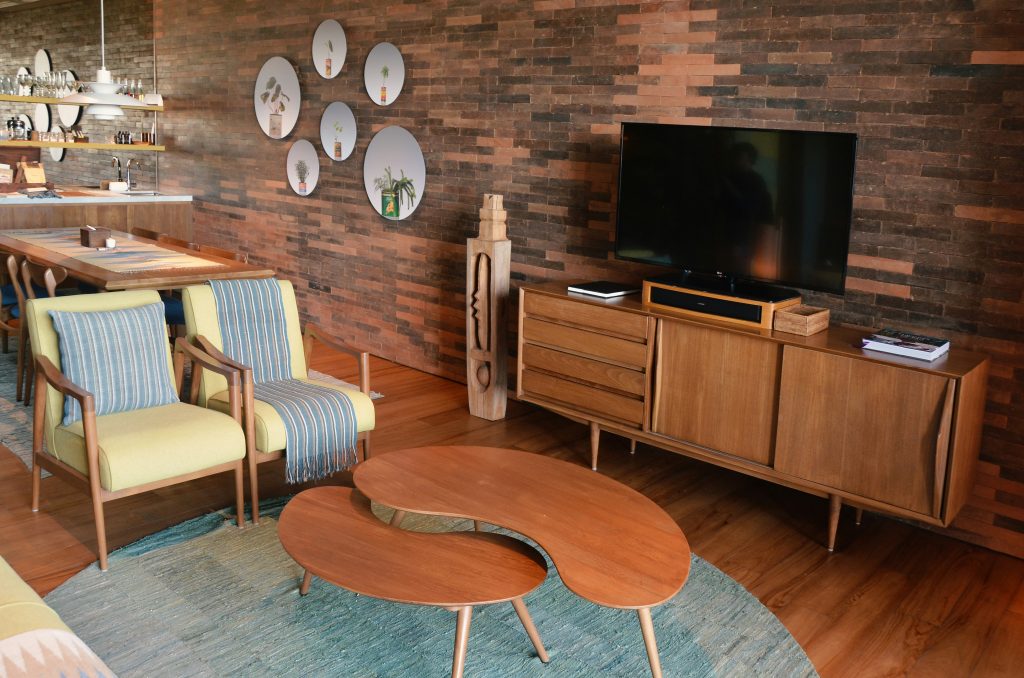
Rather than concealing structure, designers exposed it. Wood grain was celebrated. Steel remained visible. Brick and concrete were left raw.
Technological advances in moulded plywood and laminated veneers enabled new sculptural forms. Furniture could curve without excessive weight. Chairs became lighter. Storage units more modular.
Material innovation was not aesthetic indulgence—it was functional evolution.
Proportion, Lightness and Raised Forms
Mid-Century Modern interiors often appear visually lighter than earlier domestic styles. This is achieved through elevated furniture and open negative space.
Sofas, credenzas and lounge chairs frequently rest on tapered legs. This architectural lift allows light to travel beneath forms, preventing visual heaviness—particularly important in compact post-war housing.
Rooms are composed with restraint. Walls remain largely unadorned. Furniture aligns with structural lines. Balance is achieved through spacing rather than excess decoration.
Proportion governs atmosphere.
Geometry and Organic Balance
Although rooted in geometric discipline, MCM does not feel rigid.
Straight planes are softened by organic silhouettes—curved chair backs, sculptural armrests, rounded tabletops. This balance between rational structure and human-scale softness distinguishes MCM from stricter modernist movements.
The result is warmth within order.
Integration with Landscape
Particularly in regions such as California, architects emphasised continuity between interior and exterior. Floor-to-ceiling glazing, sliding doors and low horizontal profiles dissolved boundaries between domestic space and nature.
Light became an architectural element.
The relationship between interior volume and surrounding environment remains a defining aspect of the movement.
Colour as Controlled Accent
Mid-Century Modern palettes are deliberate rather than decorative.
Warm wood tones—particularly walnut—form the base. Accents such as burnt orange, olive green or mustard appear sparingly. Colour supports structure; it does not dominate it.
This restraint contributes to the style’s longevity.
Mid-century interiors often relied on carefully balanced colour schemes that combined warm wood tones with retro shades like mustard, olive and burnt orange. These combinations are explored in our guide to mid-century modern colour palettes.
Enduring Relevance
These ideas also influenced the architecture of the period, where open layouts, large windows and functional design became central features. You can explore this further in our article on mid-century modern architecture.
Mid-Century Modern persists not because of nostalgia, but because its principles remain structurally sound.
It prioritises:
• Functional clarity
• Human-scale proportion
• Honest materials
• Spatial balance
These values transcend trends.
To define MCM, therefore, is not to catalogue furniture silhouettes—it is to recognise a design philosophy grounded in modernity, discipline and material confidence.